
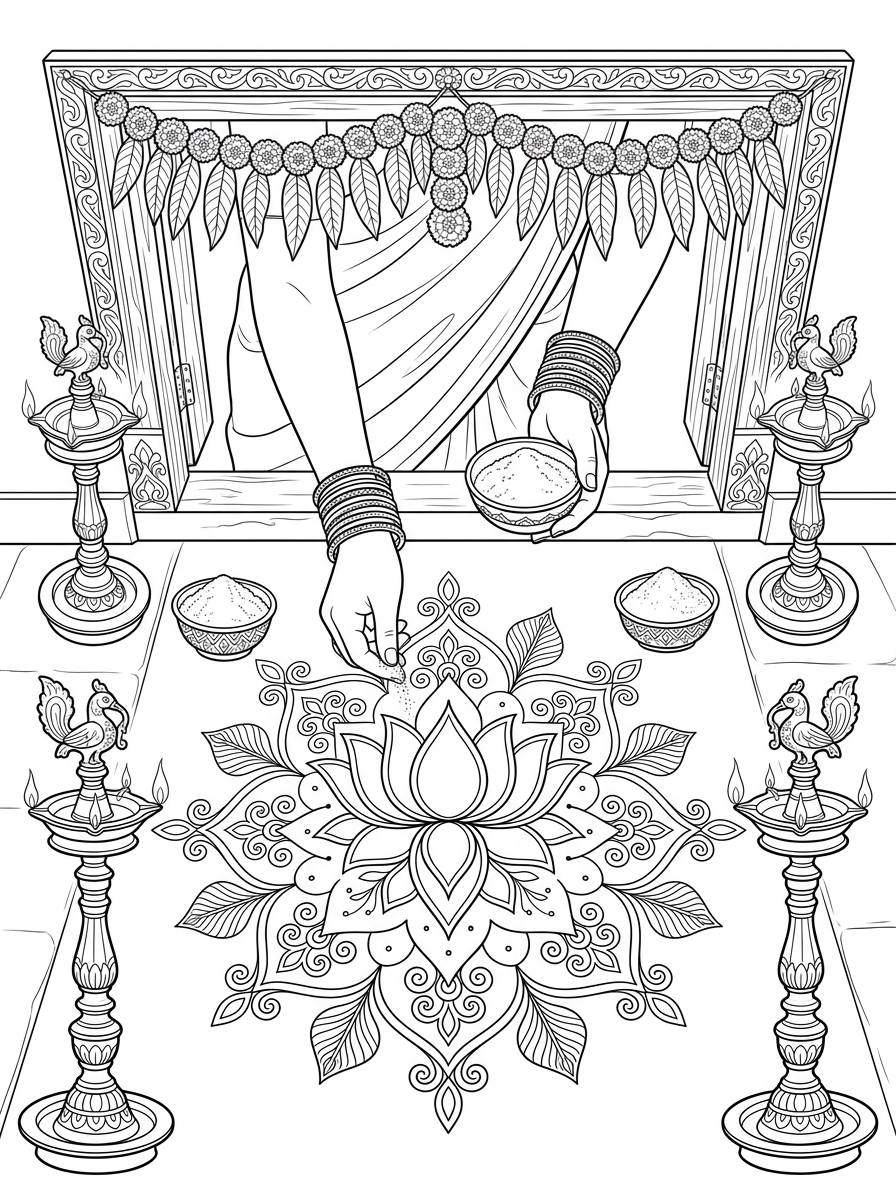
Every morning at dawn across Tamil Nadu and South India, millions of women sweep their doorsteps, sprinkle water, and begin an ancient ritual: drawing geometric patterns using coarse white rice flour. Known as Kolam (and specifically Sikku Kolam or Brahma Mudi when continuous loops are woven around a grid of dots), this tradition is widely admired for its visual elegance and welcoming auspiciousness. But beneath its devotional surface lies a profound mathematical foundation that has captivated computer scientists, topologists, and ethnomathematicians across the globe.
Far from being arbitrary decorative doodles, traditional Sikku Kolams are rigorous algorithmic exercises in discrete geometry, graph theory, and topological knot design. Understanding these geometric principles reveals how ancient artisan practices intuitively mastered mathematical concepts centuries before formal European algebraic notation emerged.
1. The Dot Matrix (Pulli Grid) as a Coordinate Space
Every Sikku Kolam begins with an ordered array of dots, called Pulli. These dots function as an invisible coordinate lattice. Common grid systems include:
- Nerkodu Pulli (Square Lattice): An m × n Cartesian matrix where dots align in parallel vertical and horizontal rows.
- Idukku Pulli (Hexagonal / Triangular Isometric Lattice): Dots in alternating rows are staggered into the valleys of the preceding row, creating 60-degree equilateral triangles. This geometry maximizes packing density and provides six natural axes of symmetry.
- Chuzhi Pulli (Radial Lattice): Dots placed along concentric circles expanding outwards from a single central bindu.
The artisan does not connect the dots with straight lines; rather, the dots act as spatial singularities or obstacles around which a continuous, fluid line must navigate without collisions.
2. Eulerian Paths and the Single Endless Thread
In 1736, Leonhard Euler solved the Seven Bridges of Königsberg problem, establishing the foundations of graph theory. Euler proved that a graph contains a closed path visiting every edge exactly once (an Eulerian circuit) if and only if every vertex has an even degree.
In traditional Indian folk classification, the highest mastery of Sikku Kolam is called Ondraga Mudiyum Kolam — a design where an entire intricate, room-spanning pattern is drawn from start to finish using one single, unbroken continuous line that never crosses itself improperly and returns seamlessly to its origin. Topologically, the artisan generates an alternating knot projection where the path loops gracefully around each pulli dot, ensuring that the visual space is evenly partitioned into interior and exterior topological manifolds.
3. Dihedral Symmetries (D4 and D8)
Kolams possess strict mathematical group symmetries. In group theory, the symmetries of a regular polygon are described by dihedral groups:
- D4 Symmetry (Order 8): Four rotational symmetries (90°, 180°, 270°, 360°) combined with four reflectional axes (horizontal, vertical, and two 45° diagonals). This is the hallmark of threshold Kolams designed to protect sacred domestic boundaries.
- D8 Symmetry (Order 16): Eight rotational and eight reflectional symmetries, creating lotus-like radial blooms.
- Translational & Frieze Symmetries: Along threshold borders, repeating linear patterns exhibit the seven classic mathematical frieze groups, symbolizing continuous, unbroken prosperity.
4. Cognitive Mindfulness and Neurological Flow
Drawing a complex Sikku Kolam requires immense spatial working memory, predictive planning, and fine motor precision. The artisan must hold the global symmetrical balance in mind while executing localized curve curvature with rice flour pinched between the thumb and forefinger.
Cognitive neuroscientists studying traditional makers note that executing these symmetrical paths engages bilateral hemispheric coordination, inducing an alpha-wave mental state identical to deep meditation. The practice transforms abstract topological algorithms into an accessible daily somatic ritual.
5. Bringing Kolam Geometry into Modern Digital Canvases
In digital collaborative environments like வர்ணம், understanding Kolam geometry offers artists powerful frameworks for collaborative composition:
- Shared Symmetry Planes: Two artists can split an 8-fold radial Kolam across the central divide, each completing 4 quadrants while matching rotational angle and loop curvature.
- Alternating Loop Handoffs: One artist creates the outward flowing loop; the other responds by completing the returning knot, creating an interconnected collaborative tapestry.
"Kolam is not merely art on the floor; it is a living mathematical conversation between human memory, spatial rhythm, and the sacred geometry of the universe."